

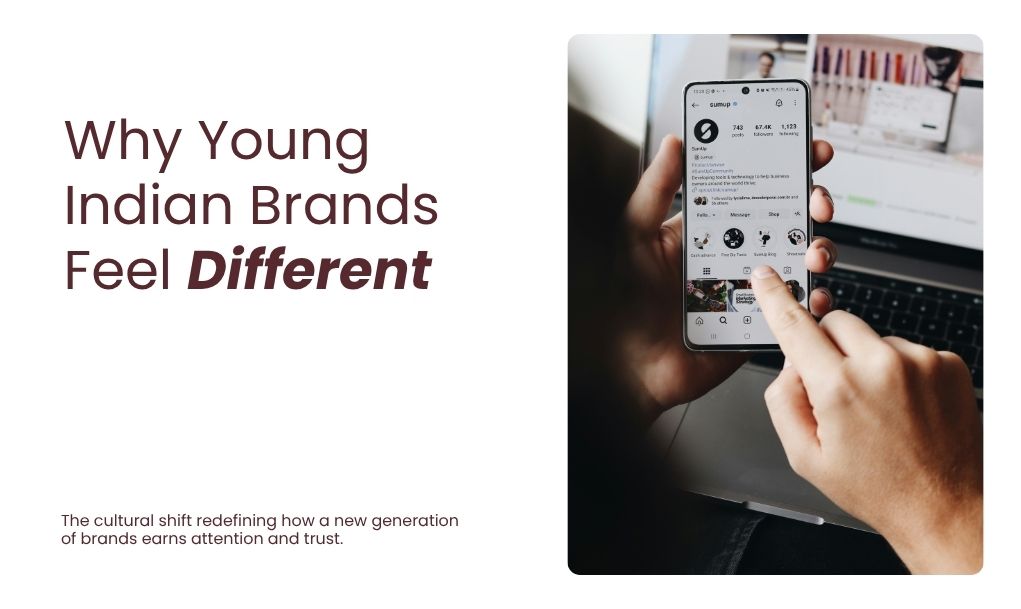
Spend a few minutes on the Instagram pages of young Indian brands today, and you’ll notice something curious. Many of them don’t sound like brands at all. Founders appear in videos. Teams share work-in-progress. Product launches come with personal stories. Captions feel conversational rather than carefully scripted. The communication feels less like marketing and more like participation.
At first glance, this can seem like a stylistic shift. But we think something deeper is happening. For decades, brands were taught to create distance. Credibility came from looking polished, sounding authoritative, and appearing larger than life. The more established a brand felt, the more trustworthy it seemed.
Yet many of today’s most interesting brands are doing the opposite. They’re bringing people closer. Instead of hiding the process, they’re sharing it. Instead of speaking through a corporate voice, they’re speaking through people. Instead of presenting a finished story, they’re inviting audiences into the journey. And consumers seem to be responding.
Take Indē Wild. The founder is deeply embedded in the communication itself. Product education sits alongside personal experiences, community conversations, and cultural references. The audience doesn’t just learn about the product; they understand the thinking behind it.
 Image via indē wild – (https://www.instagram.com/indewild?igsh=N3pnZmhxMjF1M24z)
Gully Labs approaches this differently. Its content often explores Indian craft, design, and culture as much as it does furniture. The product exists within a larger worldview, making the brand feel more like a cultural participant than a retailer. Image via gullylabs – (https://www.instagram.com/gullylabs?igsh=MXVweThoMWdzZW9paQ==)
The same pattern appears across brands like Studio Medium and Mille. While operating in different categories, both communicate through a distinct point of view. The audience isn’t only buying a product. They’re buying into a perspective.
And that’s where the real shift lies. Many young brands aren’t building from category first. They’re building from conviction first. They’re not just asking:
“How do we sell this?”
They’re asking:
“What do we stand for?”
“What conversations do we belong in?”
“Why should people care beyond the transaction?”
Part of the answer lies in how trust itself has evolved. This shift isn’t really about marketing. It’s about how people have learned to trust online. For a generation raised on creators, direct access feels normal. A founder explaining a product on Instagram often feels more credible than a perfectly produced campaign. The distance that once signalled authority can now feel impersonal. The proximity that once felt unprofessional can now feel authentic.
And perhaps that’s the bigger implication of all this. The most relevant brands today aren’t competing on products alone. They’re competing on perspective. Because in a market where products can be copied, a point of view is much harder to replicate.
That’s why so many young Indian brands feel different. Not because they’re abandoning the principles of branding, but because they’re responding to a new reality: people no longer connect with brands through advertising alone. They connect with what a brand believes, participates in, and contributes to culture. And increasingly, that’s what makes a brand worth following long before it becomes worth buying.